Am I Balding, Or Is It Just A Cowlick?
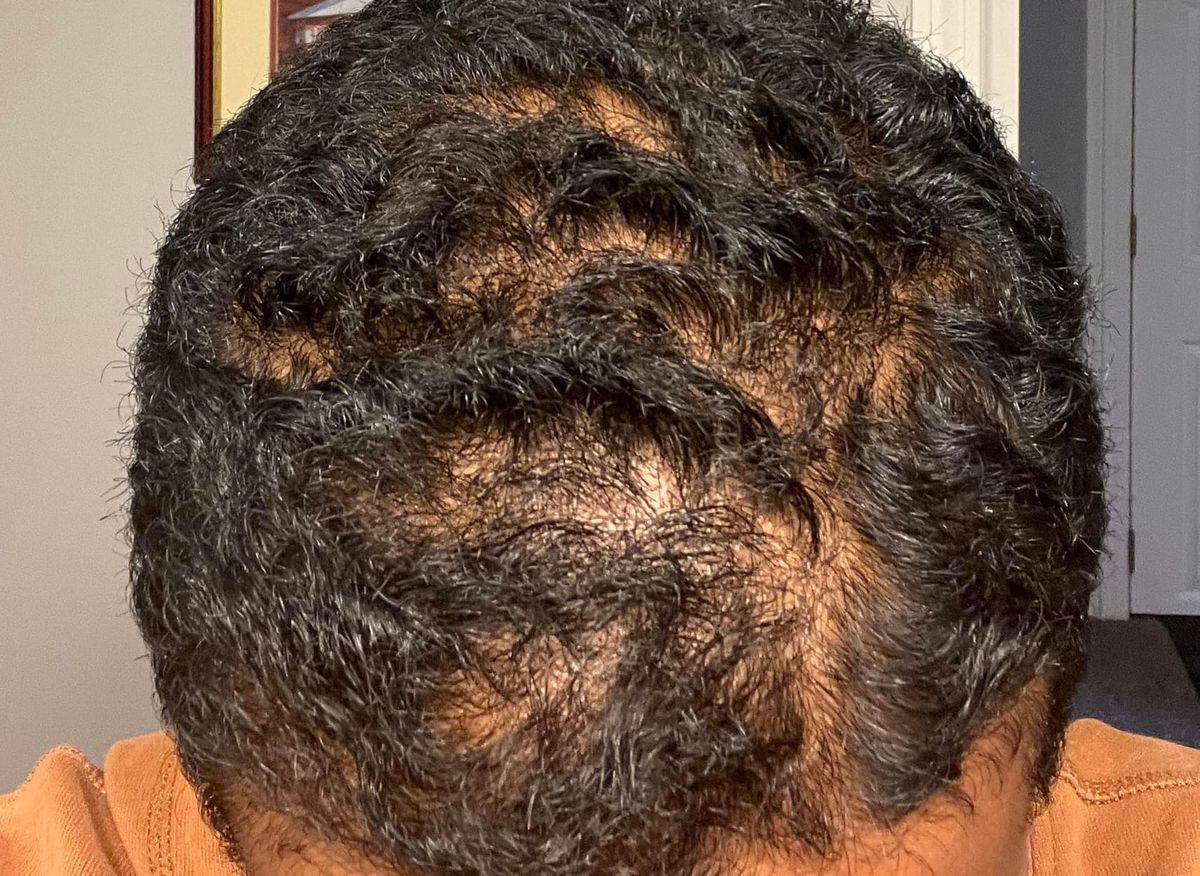
A cowlick is a harmless, genetic swirl pattern you've had since birth, it doesn't get worse. A balding crown is progressive hair loss (androgenetic alopecia) where follicles shrink over time and the bald patch grows. The fastest way to tell them apart: track whether the spot changes size over a few months.
Sound familiar? -You're standing between two bathroom mirrors, phone flashlight in hand, tilting your head at an angle that would alarm a chiropractor. You've just spotted something on the back of your scalp: a patch where you can see skin. Now you need to know: is this just how your hair has always grown, or is this the beginning of the end?
That panic has a name, and it's one of the most-searched hair questions there is. The good news is that the two things you're comparing aren't actually similar once you know what to look for.
A cowlick is a hair whorl, a spot where your follicles grow in a spiral instead of lying flat like the rest of your hair. It's determined by genetics and set during scalp formation before you were even born. It's been there your whole life, even if you're only noticing it now that your hair is shorter or thinner overall.
A balding crown is androgenetic alopecia (male or female pattern hair loss), a process where hair follicles gradually shrink, or "miniaturize," producing progressively finer, shorter hairs until the follicle stops producing hair at all. Unlike a cowlick, it's a process, not a fixed pattern. That means it changes shape and size over time, while a cowlick doesn't.
Because cowlicks so often show up at the crown, the same spot where pattern baldness typically starts, it's an easy mix-up to make. The rest of this guide gives you the exact tests to tell them apart.
Cowlick vs. Balding Crown: Quick Comparison
| Feature | Cowlick | Balding Crown |
|---|---|---|
| Hair growth pattern | Grows outward in a tight, uniform spiral | No spiral pattern; hairs may lie flat or grow in random directions |
| Hair thickness | Consistent thickness throughout the swirl | Progressively thinner (miniaturized) hairs near the center |
| Scalp visibility | Visible only under bright, direct light or a flashlight | Visible under normal indoor lighting, even from a few feet away |
| Onset | Present from birth | Can begin as early as the late teens in men; in women, often later, frequently accelerating after menopause |
| Progression over time | Stays the same size and shape for life | Spreads outward and gets more visible over months to years |
| Symmetry | Small, localized, single point of origin | Often expands to merge with a receding hairline (Norwood scale in men, Ludwig scale in women) |
| Touch test | Hair density feels the same as the rest of your scalp | Area feels noticeably sparser than the sides and back |
The 3-Step Mirror Test
No new claims here beyond what we've already verified, just a practical way to apply it. Grab two mirrors (or your phone's front camera) and good lighting.
1. The Direction Test
Look at how the hair grows out of the spot in question. Does it form a tight, uniform spiral, with every hair radiating outward from a central point in the same rotational direction? That's a hair whorl doing exactly what it's designed to do. If the growth pattern looks irregular, flat, or like there's no clear spiral at all, that points away from a cowlick.
2. The Thickness Test
This is the test that actually catches early balding. Look closely at individual hairs in the center of the swirl and compare them to hairs on the sides of your head. In a cowlick, every hair should be the same thickness, since it's a directional pattern, not a density change. If the hairs at the center are visibly finer, shorter, or more see-through than the hair elsewhere on your scalp, that's miniaturization, the hallmark sign of androgenetic alopecia.
3. The Parting Line
Check how the scalp exposure is shaped. A cowlick shows scalp at a single, small, consistent point, the center of the spiral, and nowhere else. If you're seeing scalp spreading outward, connecting toward your part line, or expanding beyond that one central point, that's a pattern of loss, not a whorl.
The tiebreaker: take a photo today. Cowlicks don't change. If you check back in three to six months and the spot looks the same, you likely have your answer. If it's visibly bigger, that's worth a conversation with a dermatologist.
60-second self-check
Am I Balding, Or Is It Just a Cowlick?
Answer the three mirror-test questions from the article. No signup required to see your result.
Question 1 of 3
Does the hair grow in a tight, uniform spiral?
Question 2 of 3
Are the hairs at the center of the spot noticeably thinner than hair on the sides of your head?
Question 3 of 3
Is the visible scalp limited to one small point, or is it spreading?
Free newsletter · unsubscribe anytime
Comments ()